A working guide to shading a Kyalami property — the real sun angles at 26° south, the storm season, the estate architectural rules, and what we would actually specify wall by wall. Free to read, nothing gated, every claim sourced at the foot of the page.
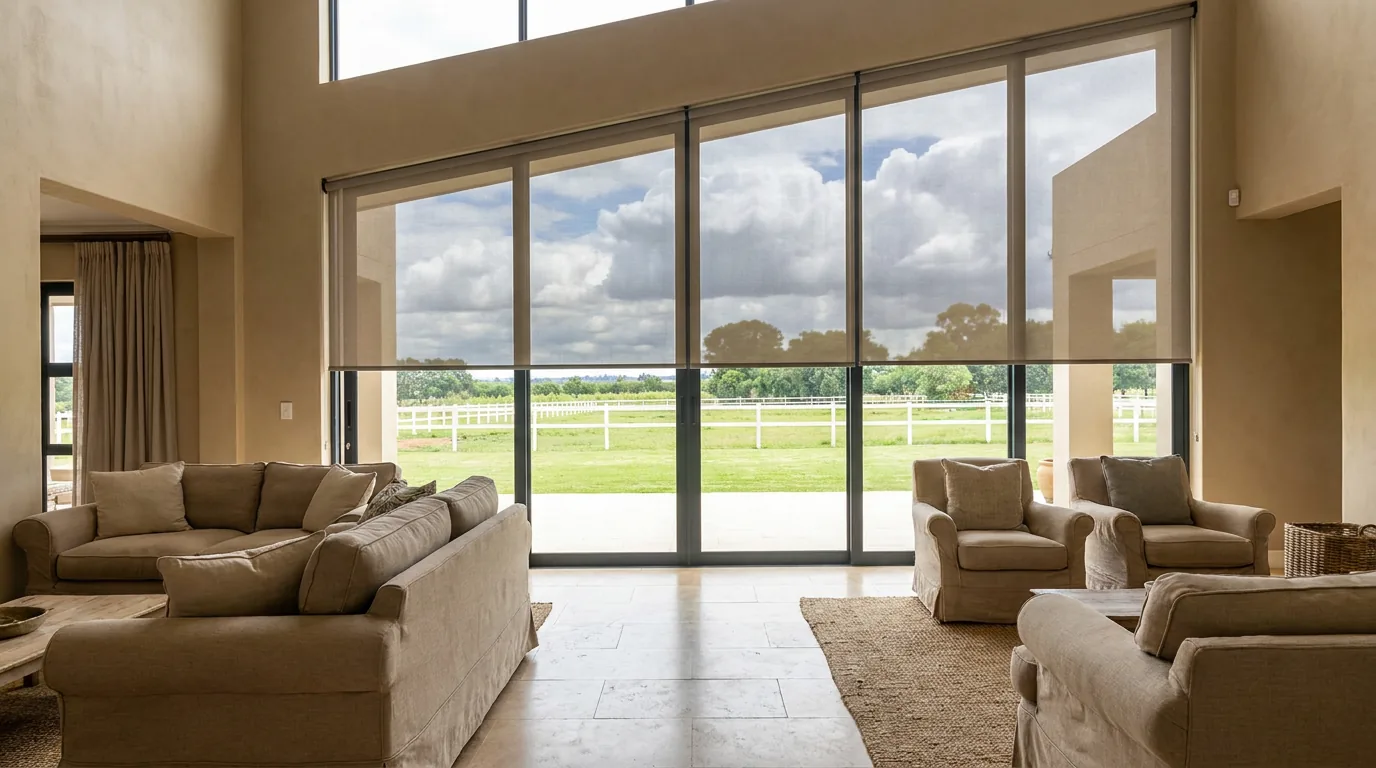
Kyalami Estates went up around 1988, when Anglo American Properties laid roughly 994 houses across 1.68 km². Minutes away, Kyalami Agricultural Holdings spreads 3,299 people over 18.07 km² — some 183 per square kilometre. Around both sits the equestrian belt: Waterfall Equestrian Estate on stands of 8,000 to 10,000 m², Blue Hills from 5,000 m² up.
That is the brief in one number. A dense older suburb gets shade for free — the neighbour’s double storey, a street tree line, a wall that kills the last hour of sun. On a stand with paddock on three sides, none of that exists. Every scrap of shade here is shade somebody specified.
The second thing is how these houses are built: two storeys, the big glazed rooms turned to the view, six-panel stacking doors, double-volume windows over a stairwell. That changes the question from which fabric to how will anyone reach it — a blind nobody can operate stays open.
Kyalami sits at about 26° south, roughly 1,467 m above sea level. The nearest published sun-path study is for Pretoria, a quarter-degree north: the sun there reaches 87.7° at midday on 21 December and only 40.84° on 20 June. At our latitude those shift by a third of a degree — so, about 87° in midsummer, 40° in midwinter.
That gap is the most useful thing to know about a north-facing window. In December the noon sun is nearly overhead, so a north window under a decent eave largely shades itself. In June it is barely 40° up and due north, reaching across the room — which you want, because Midrand nights drop to around 5 °C in July. Anything permanent you bolt over north glass takes that winter warmth with it.
West is a different animal. On 21 December the sun sets at an azimuth of 243° — about 27° south of due west. It arrives low, almost horizontal, at the hour the house is already hottest; the same study shows “how much hotter the afternoons (western exposure) are in comparison with the mornings”. No overhang blocks a horizontal ray, so we put something at or outside west glass.
Your best rooms face this way and in winter they earn their keep. A generous eave handles the December midday sun; the trouble is the shoulder hours, when the sun swings east or west and slides underneath. The job here is not blocking but modulating.
This is where the money goes. The last two hours of December light arrive almost level with the floor, into rooms that warmed all day. An interior blind stops the glare, but the pane still radiates heat inwards. If a west room is uncomfortable rather than merely bright, the fix sits outside the glass.
East glass gets the same low geometry, but at six in the morning, into a house that cooled overnight. The complaint is rarely temperature — it is being woken at first light. So east is usually solved inside the glass, for a fraction of what a west wall costs.
South rooms take no direct sun of consequence. They stay evenly lit and cold in winter, which is why so many south bathrooms feel damp in July. Do not spend here on solar control — spend it on keeping warmth in.
Tell us which rooms or walls are the problem and we will email this guide back with notes against your elevations. No visit is booked and nobody phones you.
Every one has a downside. The grey box says what it is.
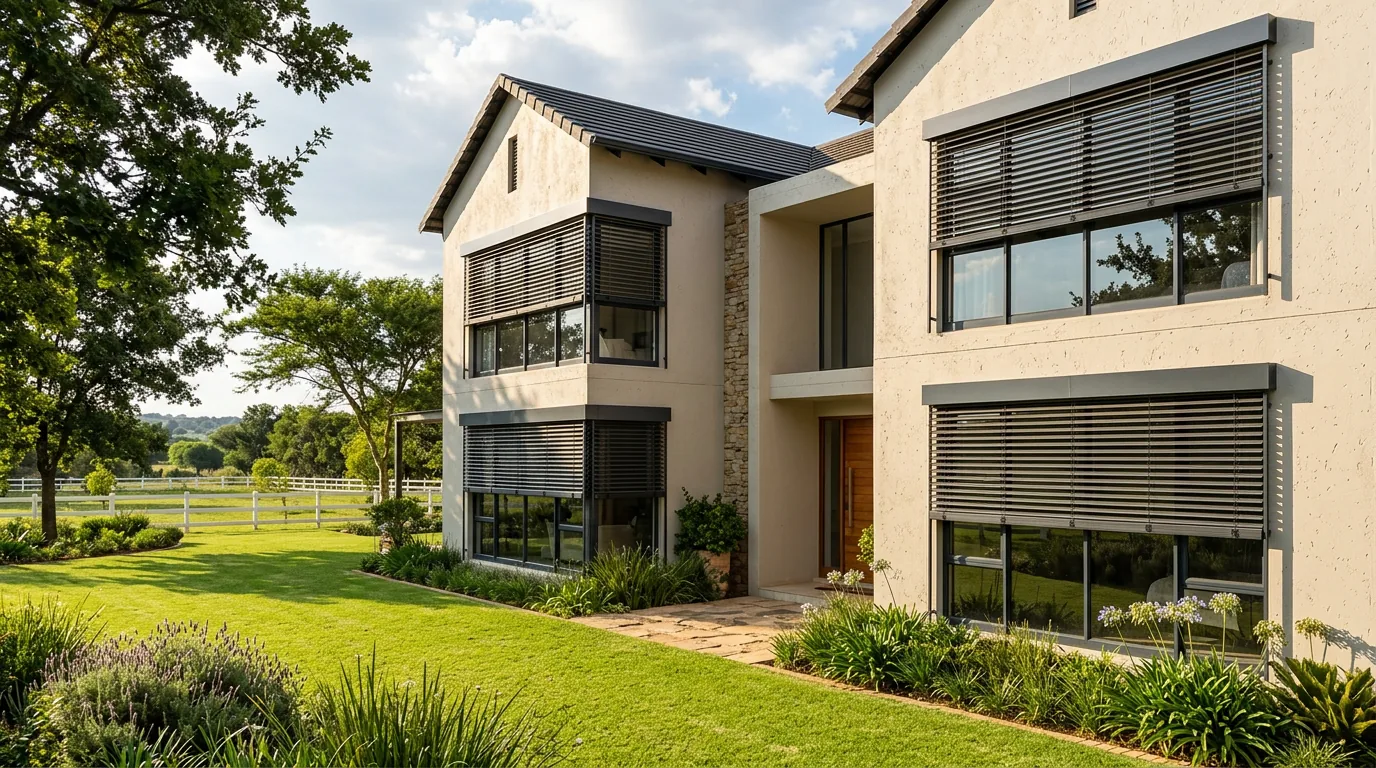
We would specify these over an interior blockout roller on a hard west wall: stopping the sun outside the glass keeps a room genuinely cooler than absorbing it inside, where the pane still radiates inwards. Tiltable slats kill a horizontal 4pm ray and keep the paddock in view.
The dearest thing here; it needs a motor and wind sensor on the Highveld, and estate approval, being visible from outside.
Two fabrics, one mechanism. A sunscreen open weave is the default where the point of the window is the view: it cuts glare and a share of the heat while you still see the arena and the sky. A blockout coating is the east-bedroom answer, stopping the 5:30am sunrise dead — fitted outside the reveal, because an inside mount leaks a bright line down each edge.
Sunscreen is not privacy: after dark it shows a silhouette. Blockout is binary — dark at midday or full glare. A bedroom used in the afternoon wants both, on a double bracket.
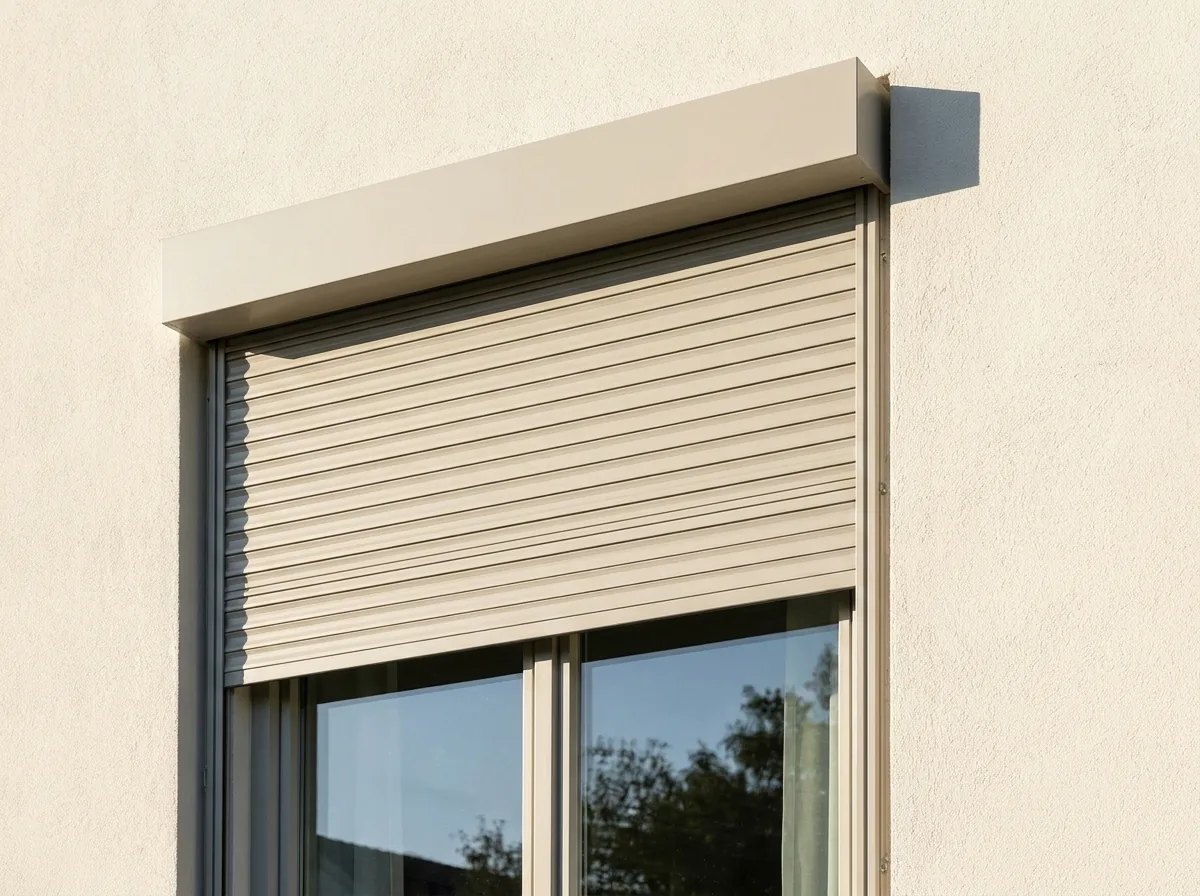
Rigid aluminium slats rolling down from a headbox outside the window, so the curtain sits in front of the glass. On a west bedroom that bakes until nine at night they beat any interior product. These are shading shutters, not security shutters — a different product, available on request.
Fully down they are dark, and they read as a solid element on the facade — exactly what an aesthetics committee looks at. On an existing house the headbox usually shows.
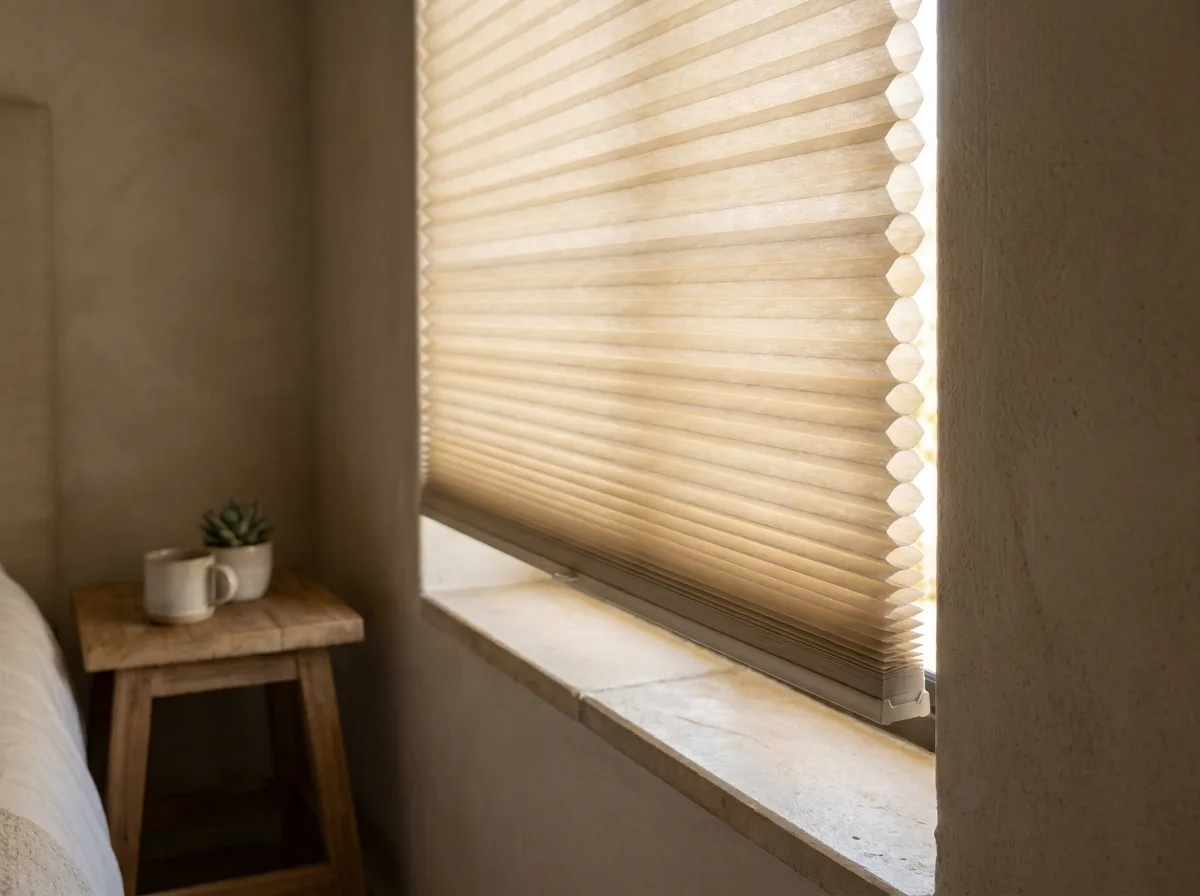
The fabric folds into hexagonal cells that trap still air against the glass, insulating as a single sheet cannot. On a south wall — no direct sun, cold in July — that layer beats any solar coating.
A fabric structure, so not for a steamy bathroom or a window left open beside a gravel driveway. Aluminium venetians wipe clean; cellular does not.
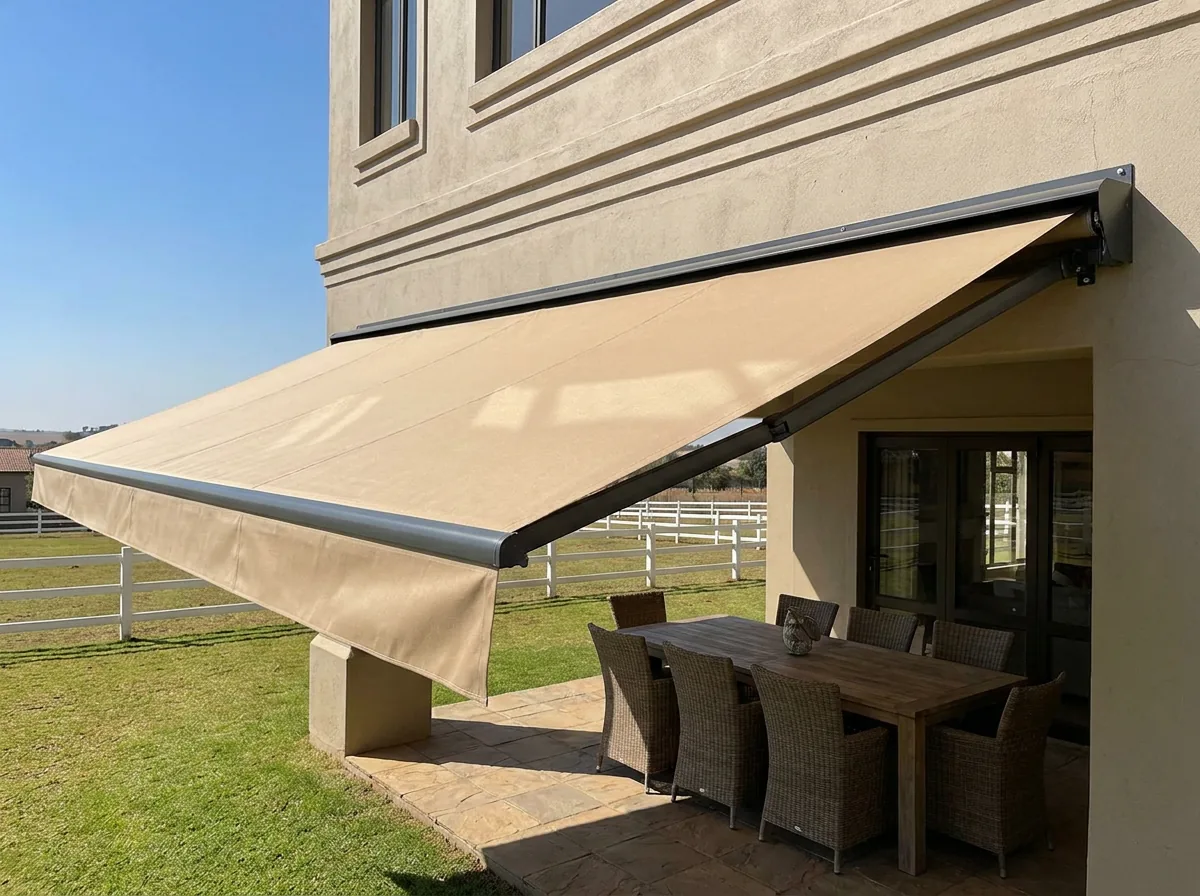
Shade over the paving on demand, no posts in the way of the view, folded clear for the cool evenings of April — and it shades the outdoor room and the glass behind it. On an exposed stand, pair it with zip screens: mesh in side channels the wind cannot lift out.
Both are sun-and-wind products, not storm products. In an October thunderstorm the awning must retract, so on open ground we fit only motorised ones with a wind sensor.
On a double-volume window over a stairwell this is not a luxury — it is the difference between a blind that gets used and one left open for three years because nobody wants the ladder. It is also the cleanest child-safe answer: no cord or chain in the room at all.
Power has to get there — a cable chased into a plastered wall, or a rechargeable motor you take down twice a year. Which one applies is a site question.
Inside Kyalami Estates, read your architectural guidelines before ordering anything visible from outside. Version 4, dated 20 July 2024, is on the estate’s website; three parts reach us directly.
Two more before you pick a colour or a fixing. External walls must be painted in natural earth tones — white, beige, taupe, grey — so a strong-coloured exterior product invites trouble. And windows must be timber or powder-coated aluminium, not steel, so that is what we fix into.
None of this applies automatically outside the estate: Beaulieu, Blue Hills, Chartwell, Waterfall and the Kyalami AH smallholdings each have their own rules, or none. We are blind fitters, not your committee — but we will supply spec sheets, colours and drawings it can assess.
All true of Kyalami. None of it true of your house until somebody stands in the room.
Whether a blind sits inside the reveal or has to face-fix comes down to millimetres, and to what is behind the plaster — brick, lintel or dry-lined bulkhead. That decides the bracket, sometimes the product.
Plans say “west”; the compass says 262°, or 238°, and a south-west wall takes a very different December afternoon to a north-west one. We specify to the bearing.
Awnings and zip screens live or die on this. A sheltered courtyard and an open corner across two hectares of paddock need different projections.
Where the nearest circuit is, whether a cable can be chased without opening a feature wall, or whether a rechargeable motor is cleaner. Two minutes with a torch settles it.
Guidelines differ estate to estate and get revised. We would rather read your current pack than fit something that comes down again.
A consultant comes out with samples, measures every opening, takes the bearings off the walls and leaves a written quote per window. It costs nothing and commits you to nothing. Would rather have a rough number first? The ballpark tool is inside the form.
Our consultant does five to six measures a week across this area, so the diary fills early — worth booking ahead if you need a particular day.
Anything you ticked while reading is already in the form — no retyping.
Not ready for a visit or a number? Tell us which rooms are the problem and we will email this guide back with notes against your own elevations.
Or simply keep the page: what the sun does here, what we would fit and why and what a site visit settles stay free and un-gated.
Every climate, geography and estate-rule claim above traces to one of these. Where we have reasoned rather than cited, we have said so in the text.
Three honest caveats. The solar figures in source 6 are calculated for Pretoria at 25.73° south; Kyalami sits at about 26.00° south, so its own angles differ by roughly a third of a degree — we have quoted the published Pretoria numbers rather than invent our own. We could not retrieve the full text of source 10, only its published abstract, so it supports the hail and storm-timing points rather than carrying them alone. And the estate rules in section 05 are Kyalami Estates’ own; they do not apply automatically anywhere else in the belt, and they are revised from time to time — always read your current pack.
Free in-home measure, a written quote per window, and a real consultant on the phone before anything is made.
Book your free measure